
Table of Contents
- Solar Charger vs Power Bank: The Core Difference
- How Energy Storage Works: Battery vs Solar Generation
- Solar Panel or Power Bank for Backpacking: Which Fits Your Trip
- Power Bank Capacity for Camping: How Much Do You Actually Need
- How to Choose a Solar Charger for Real Conditions
- Portable Power Station for Camping: When to Step Up
- Weight, Reliability, and Weather: The Trade-Offs That Matter
- Conclusion
- Frequently Asked Questions
Last Updated: October 13, 2026
Solar Charger vs Power Bank: The Core Difference
When you're planning a camping trip, one question keeps coming up: how do you decide in a solar charger vs power bank comparison? The answer depends entirely on how long you're away and what conditions you'll face.
A solar charger is a portable solar panel that converts sunlight directly into electricity to charge your devices. A power bank is a rechargeable battery that stores energy you've charged at home and deploys it on demand. The solar charger generates power in real time when the sun hits it. The power bank carries pre-stored energy and doesn't care about weather or daylight.
This difference shapes everything else: weight, reliability, capacity, speed, and how well each option actually works in the field. Understanding this core distinction helps you avoid the most common mistake: choosing based on marketing promises instead of real-world camping conditions.
Most guides treat these as interchangeable options. They're not. A solar charger on a rainy weekend is nearly useless. A power bank on a two-week backcountry trip might leave you stranded. The choice isn't about which is "better", it's about matching your trip to the tool that fits.
How Energy Storage Works: Battery vs Solar Generation
Power banks store energy in rechargeable lithium-ion or lithium-polymer batteries. You charge them fully at home, they hold that charge for weeks or months, and you draw from that stored pool whenever you need power.
Solar chargers work differently. They generate electricity on the fly whenever sunlight hits the panel. No sun, no power. Clouds reduce output significantly. Shade cuts it further. You're not drawing from a battery reserve, you're tapping into real-time solar generation, which varies dramatically by time of day, season, latitude, and weather.
This explains why power banks dominate casual camping. You charge them once at home and forget about them. Solar chargers require active management: positioning them correctly, monitoring cloud cover, planning charging windows around daylight hours.
The practical implication is straightforward. For a weekend trip where you just need to top up your phone once or twice, a power bank is simpler and more reliable. For extended trips where you can't recharge at camp and need continuous power generation, a solar charger becomes valuable, but only if you understand its limitations.
Solar Panel or Power Bank for Backpacking: Which Fits Your Trip
Trip length is the decision point here. A power bank is finite. Once you've drawn all its stored energy, you're done. A solar charger, in ideal conditions, can generate power indefinitely.
For trips under three days, a power bank is the obvious choice. Most people don't need more than one or two full phone charges over a weekend. A modest 10,000 mAh power bank weighs around 6 ounces and handles this comfortably.
For trips lasting four to seven days, the decision gets more interesting. A larger power bank (20,000-30,000 mAh) still works, but now you're carrying 12-16 ounces of weight for a single-use battery.
For trips longer than a week, a solar charger shifts from optional to necessary, but only if conditions allow meaningful solar exposure. A week in the Pacific Northwest in November? A solar charger generates almost nothing useful. The same week in the Southwest with clear skies?
The real-world trade-off isn't just weight. It's the difference between carrying dead weight (a power bank that diminishes as you use it) and carrying a tool that works indefinitely (a solar charger that only works when conditions cooperate).
Power Bank Capacity for Camping: How Much Do You Actually Need
Most camping trips fail the capacity calculation because people overestimate their power needs. A typical smartphone battery is 3,000-4,000 mAh.
This means a 10,000 mAh power bank gives you about 8,000 mAh of usable output, roughly two full phone charges.
But mAh alone doesn't tell the whole story. To really match capacity to your trip, you need a simple energy budget. Here's how to build one in three steps:
Step 1: List your devices and their daily energy draw.
- Smartphone: 10-15 Wh per day (assuming moderate use, GPS off)
- GPS watch or handheld: 2-5 Wh per day
- Action camera: 5-10 Wh per day
- Headlamp: 2-4 Wh per day
- E-reader: 3-5 Wh per day
Step 2: Multiply by trip length. For a 3-day trip, total demand = (15 + 5 + 10 + 4 + 5) × 3 = 117 Wh.
Step 3: Convert to power bank capacity. Power banks are rated in mAh at 3.7V nominal. To convert Wh to mAh: mAh = (Wh × 1000) / 3.7.
That's a lot of weight. A 20,000 mAh power bank weighs about 12-14 ounces. A 40,000 mAh unit can weigh 2 pounds or more.
For a weekend trip, one full phone charge is usually enough if you're not streaming video or using GPS navigation constantly.
For a week-long trip, you might need three to four charges.
The sweet spot for most campers is a 10,000-15,000 mAh power bank. It covers two to three full charges, weighs under 10 ounces, and fits in any pack pocket.
How to Choose a Solar Charger for Real Conditions
Solar charger marketing is notoriously misleading.
But even that range is optimistic if you don't account for season, latitude, and campsite conditions. Here's what actually determines how much power you'll get:
Season and latitude. In summer at mid-latitudes (e.g., 40°N), you might get 5-6 peak sun hours per day. In winter, that drops to 2-3. At higher latitudes (e.g., 60°N), winter sun is so low and brief that solar charging becomes impractical for most trips. If you're camping in the Pacific Northwest in November, expect almost nothing. In the Southwest in June, you'll get close to rated output for several hours.
7-Color Rechargeable Camping Lantern →
Shade and cloud cover. Even partial shade from a single tree branch can cut output by 50-80%.
Panel angle. A panel lying flat on the ground collects far less energy than one angled perpendicular to the sun.
Temperature. Solar panels lose efficiency as they heat up. A panel in direct sun can reach 140°F, reducing output by 10-25%. Keep panels ventilated if possible.
When evaluating a solar charger, focus on these practical factors:
Panel size and weight. Larger panels generate more power but weigh more. A 10W panel might weigh 6 ounces and fold into a pack easily. A 30W panel could weigh 2 pounds. For backpacking, the weight penalty often outweighs the power gain.
Build quality and durability. Solar panels are fragile. Look for chargers with reinforced frames, water-resistant casings, and proven durability in field use.
Charging method. Some solar chargers charge a built-in battery first, then charge your phone from that battery. Others charge your phone directly from the panel.
Port compatibility. Ensure the charger has USB-C, USB-A, or whatever ports your devices use. Many modern solar chargers have multiple ports, but check before buying.
Real-world output expectations. Under typical field conditions (partly cloudy, mid-day, temperate latitude), expect 30-50% of the rated output. A 20W panel might generate 6-10W in real use.
The common mistake is buying a solar charger expecting it to replace a power bank. It doesn't. It supplements one.
Portable Power Station for Camping: When to Step Up
A portable power station is a larger, heavier alternative that combines a big battery with multiple ports and sometimes solar charging capability. These range from 100Wh capacity (small, 1-2 pounds) to 2000Wh or more (heavy, 20+ pounds).
For car camping or base camps where weight isn't a constraint, a power station makes sense. You get high capacity, fast charging, and the ability to run multiple devices simultaneously. Some models include built-in solar charging capability, which combines the benefits of both approaches.
For backpacking, a power station is overkill. The weight penalty is severe, and you're paying for capacity you won't use on a typical weekend trip.
The practical scenario for a power station is a week-long car camping trip where you're running a laptop, phone, camera, and portable lighting. You can charge it fully at home, top it up with solar panels during the day, and have reliable power throughout the week.

Weight, Reliability, and Weather: The Trade-Offs That Matter
A power bank is heavier than you'd expect for its capacity. A 20,000 mAh power bank weighs 12-14 ounces.
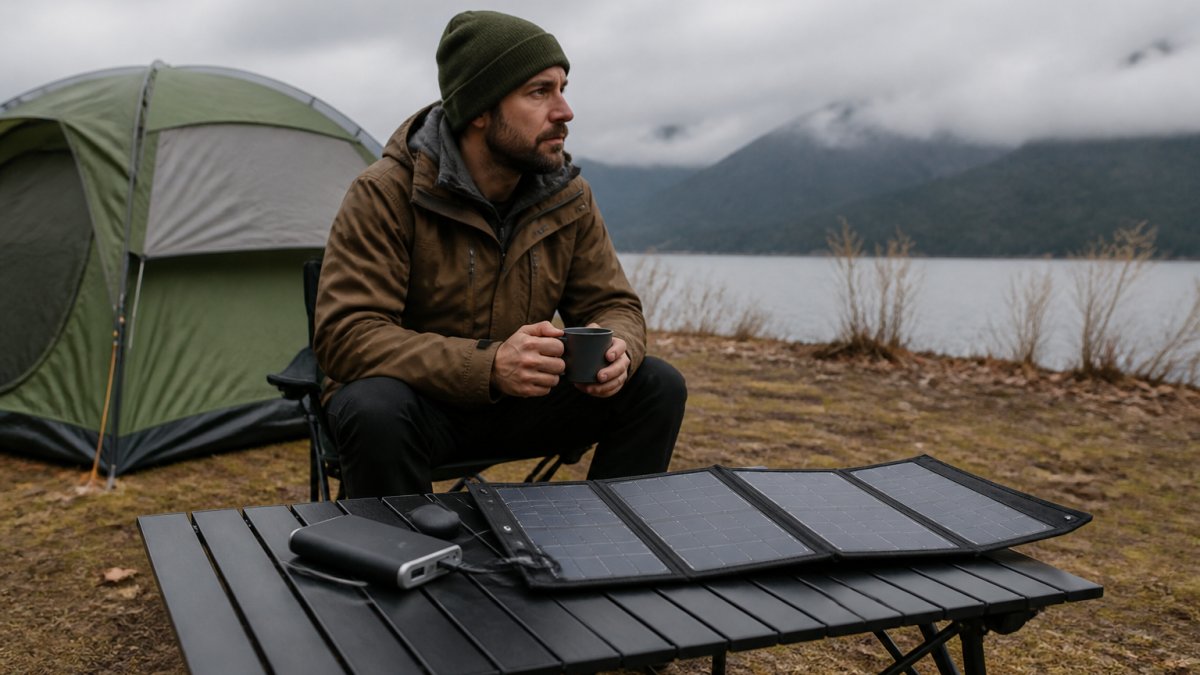
A solar charger is lighter per unit of energy potential, a 20W panel might weigh 8 ounces, but only if conditions allow it to generate power. In poor conditions, you've carried weight that produces nothing.
Weather is where these tools diverge most sharply. Power banks work in any weather. Rain, snow, darkness, clouds, none of it matters. You're drawing from stored energy. Solar chargers depend entirely on sunlight.
Reliability is straightforward: power banks are reliable. They work or they don't, and failure is rare with modern lithium-ion technology. Solar chargers are less reliable because they depend on conditions outside your control.
The real trade-off is flexibility versus simplicity. A power bank is simple: charge it, pack it, use it. A solar charger requires active management, positioning, and realistic expectations about output.
Conclusion
The choice between a solar charger and power bank depends on your trip length, expected weather, and willingness to manage charging actively. For weekend trips and reliable power, a power bank is the practical choice. For extended trips in sunny conditions, a solar charger becomes valuable.
Starting with a quality power bank is often simpler, more reliable, and covers most casual camping trips. As trips get longer or more remote, adding a solar charger can extend power independence. Many adventurers eventually carry both: a power bank for reliability and a solar panel for extended trips.
When you're ready to gear up for your next adventure, explore our curated collection of reliable outdoor essentials designed for the journeys you're planning. We offer portable lighting, charging solutions, and other essentials you need to make every camping trip a success.
Frequently Asked Questions
Is a portable solar charger or power bank better for camping?
Neither is universally better; it depends on your trip length and conditions. A power bank delivers reliable, fast charging anywhere and works in shade or cloud cover. A solar charger generates free energy in direct sunlight but charges slowly and fails on cloudy days. For weekend trips under three days, a power bank is more practical. For longer trips with reliable sun exposure, a solar charger reduces weight and eliminates the need to recharge before departure.
How much power bank capacity do I need for a camping trip?
A typical smartphone needs 2,500-3,500 mAh per full charge. For a weekend trip (2-3 days), a 10,000 mAh power bank handles two full phone charges plus buffer. For 4-5 days, aim for 20,000 mAh or higher. If you're charging a GPS device, headlamp, or smartwatch, add 2,000-3,000 mAh per device. Check your devices' battery specs and plan for one full recharge plus 20% margin for inefficiency.
Can a solar charger charge a power bank?
Yes. A solar charger with USB output can charge a power bank's input port directly. This is actually a smart strategy: carry a solar panel and a large power bank together. The solar panel trickle-charges the power bank during the day, and the power bank provides fast, reliable charging for your devices at night or in shade. This combination gives you both the redundancy of stored energy and the long-term sustainability of solar generation.
Are solar power banks worth it for camping?
Integrated solar power banks (combined charger and battery) work best as emergency backup rather than primary power. They're heavier than a standalone power bank of equal capacity, charge slowly even in direct sun, and struggle in cloud cover or shade. They're worth buying if you camp frequently in sunny climates, don't mind slower charging, and value the all-in-one convenience. For most weekend campers in temperate regions, a standalone power bank or a separate solar panel paired with a power bank is more practical.